culture & society
Why everyone is puzzling now...
Ines Imdahl
and why it's more than just a pastime and shows that there's no "New Normal" yet.
Have you also been gripped by the puzzle fever? Even though you may never have puzzled before? For you, puzzling may even have been the epitome of stuffiness, or at least a very outdated activity? At best, people used to puzzle earlier or as children. But children today actually prefer to use their cell phones.
You don't puzzle? You may still have noticed that the number of puzzle posts on Instagram, Facebook and Co. has risen dramatically in recent weeks. Maybe you were also surprised to learn that some friends or acquaintances who you had previously misjudged have become puzzlers. In any case, the traditional company Ravensburger is currently recording an enormous increase in sales of puzzles and board games. Puzzling suddenly seems to have become a popular "pastime" for many Germans.
"Passing the time" during the dark season in the second lockdown would be a seemingly reasonable explanation. When everything is closed, we may be looking for some variety in our activities within our own four walls. Nevertheless, there would be numerous alternative activities. The fact that people are puzzling in particular is primarily due to a psychological reason.
The crisis has not only shut us down, it has shattered our everyday lives.
Our daily routines and habits, our entire everyday life - everything has come off the rails. Established structures such as getting up at a certain time, having breakfast, drinking coffee or getting it to go, driving to the office or work, meeting for lunch in the cafeteria or for coffee in the kitchen - everything has to be re-sorted.
In our surveys, people tell us how difficult they find it to consistently maintain fixed daily and work routines in their home offices. Because they suddenly realize that the brief exchange with colleagues was not only an interruption to the work rhythm, but also a creativity aid. Annoying "reminders" of unfinished tasks suddenly turn out to be prioritization aids when they are completely absent. Young people in home schooling stop putting on make-up, get dressed, like many in the home office, no longer dress completely and postpone homework until late in the evening. Others, on the other hand, have renovated, re-sorted and tidied up. These latter activities are comparable to puzzling.
The "New Normal" is being invoked in the video conferences. We want to continue to present ourselves as optimistic, crisis-proof and future-oriented. We emphasize our digital development (rightly so). But a new structure, a new version, a new normal does not yet exist.
We have been in a state of emotional shock since March.
Almost every day anew. Just when we have become accustomed to a new (behavioral) rule, it is "re-regulated", re-sorted, re-decided. Or there is a mutated, even faster spreading virus, someone gets sick, you go into quarantine yourself. Planning is difficult: booking a vacation? New Year's Eve or the next birthday with at least one or two loved ones? Postponing the wedding? School with or without attendance? We just don't know. We have to keep seeing each other from week to week. Often from day to day. School sometimes demands it of us every hour. (my youngest son didn't know on several mornings whether he had face-to-face classes all day or whether part of it was moved home from 12 noon).
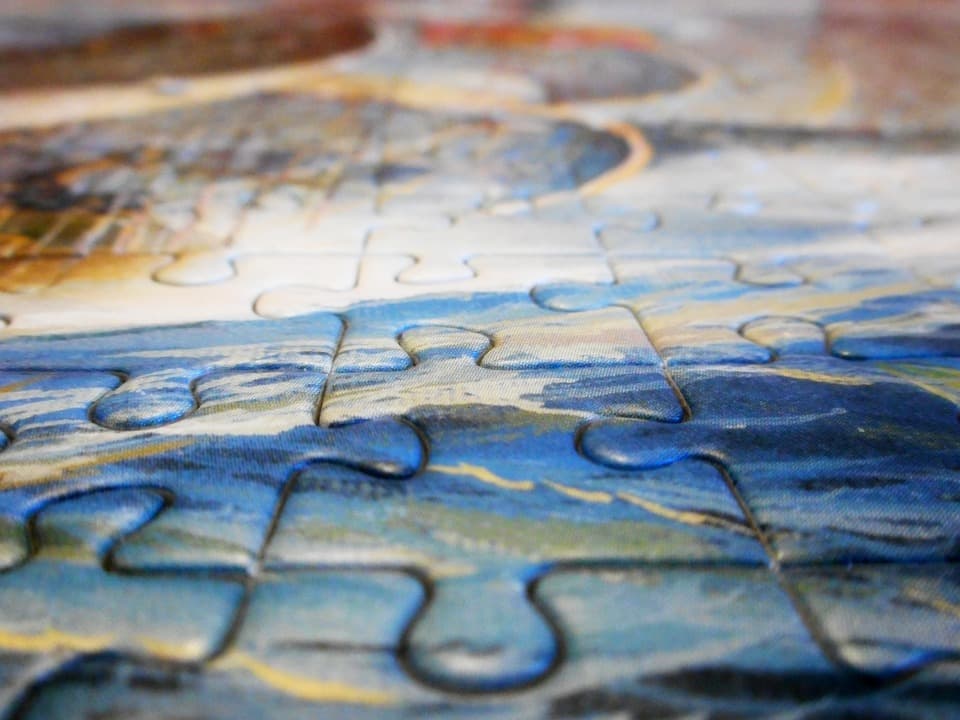
What does that have to do with puzzling? A puzzle is a disassembled whole. It symbolizes our inner life and our current everyday structure. Disassembled, plucked apart, fragmented and disordered. But we can put the puzzle back together. With the puzzle, we create a new framework for ourselves. A complete, complete (hopefully no part is missing) new order, a meaningful picture. Many parts lead piece by piece at the end to a new structure that makes sense. When we puzzle, we can get a grip on life again.
Puzzling brings our inner life - symbolically also our everyday life - back into a firmly interlocking structure.
Beyond activities such as puzzling, we are almost everywhere emotionally helpless in the crisis. We cannot currently repair, assemble and structure the broken structure of everyday life. But our psyche cannot cope with that. She has to keep trying. She doesn't want to be at the mercy of things and get bogged down in doing nothing. In the puzzle, we succeed in doing what we hardly succeed in doing in our everyday and working lives since Corona: Here we can bring together again what Corona has broken up. That is currently one of our greatest longings (which is why we are constantly invoking the New Normal, we absolutely want to have it!).
The finished puzzle provides not only a structure, but a picture. Because it comes together to form something meaningful. That too is a longing. That all the rules, regulations, all the renunciation lead to a meaningful end. Something that was good for. Something we can see, grasp and comprehend. When we have made the crisis "tangible", explained it and put it into context, then we are on the way to a "New Normal".
Until then, the puzzle is not bad for our soul hygiene. A helpful construct in the missing "normal", to find a structure and to put ourselves in order internally. But with 1000 parts and more, the puzzle is small enough to symbolically stand in for the many new rules to be observed. It lends itself as a kind of "transitional object" in the crisis: we can create a new order on the puzzle until we are able to structure a real new everyday framework, a new everyday picture, a real "New Normal". And that is more than just a "pastime".
Got the puzzle fever? Discuss with us on LinkedIn.
The article also appeared in planung&analyse.