publications, culture & society
Confidence: high in private, dead in society – Ines Imdahl's column in absatzwirtschaft
Ines Imdahl
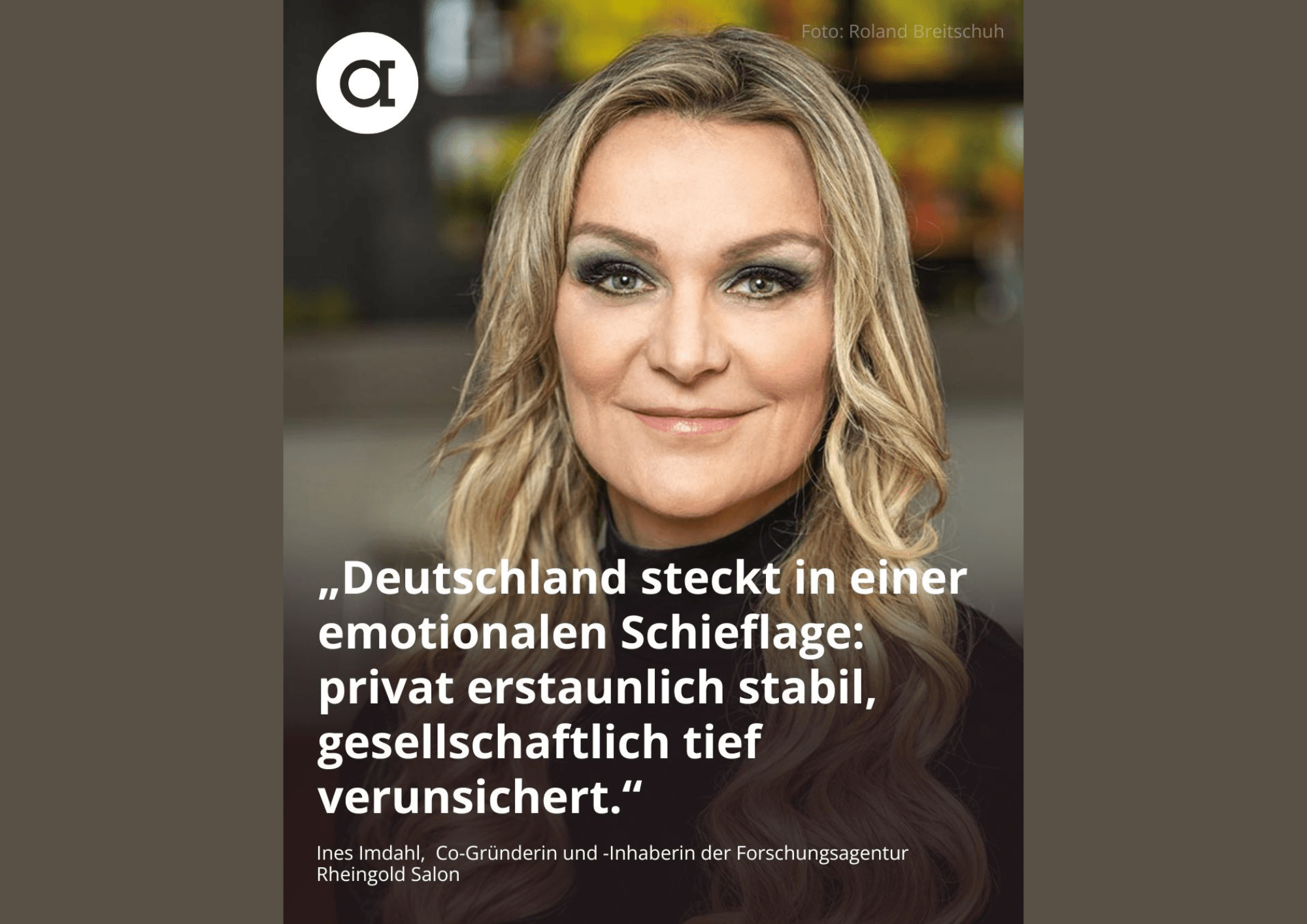
Social hopelessness coupled with private satisfaction: Germany finds itself in a confidence paradox. Why this divide is dangerous and why brands and media must now enable community. Germany is in an emotional imbalance: privately astonishingly stable, socially deeply unsettled. 85 per cent say that they and their families are doing well. At the same time, 78 per cent believe that ‘we are driving the country into the ground’. This paradoxical simultaneity is not a mood problem. It is a structural one, caused by the loss of self-efficacy in the public sphere.
People believe: ‘I have the power to act in my own life, but not in the public sphere.’ Only ten percent believe they can make a difference there. Without the possibility of self-efficacy, however, there can be no confidence in the future – especially not in society.
Learning from the small and private What follows is a retreat into the private sphere. People design kitchens, gardens, bodies, routines, relationships. They optimise their private lives – and radicalise their judgement of ‘those at the top’. Criticism of the system grows not only out of ideology, but also out of powerlessness. This helps explain why populism is thriving in the current situation.
Learning from the small and private What follows is a retreat into the private sphere. People design kitchens, gardens, bodies, routines, relationships. They optimise their private lives – and radicalise their judgement of ‘those at the top’. Criticism of the system grows not only out of ideology, but also out of powerlessness. This helps explain why populism is thriving in the current situation.
At the same time, a study* conducted as part of the ‘Project Confidence’ shows something hopeful: where people experience community and work together – in clubs, voluntary work, theatre, neighbourhoods – confidence immediately increases. 77 per cent would already be more confident if they could make a difference, at least on a small scale, and 82 per cent if society united against major threats.
Trust, confidence and willingness to change do not arise from appeals, but from experienced effectiveness in the community – even in small communities, which many have already lost today.
Doing instead of broadcasting People no longer want discouraging communication; they want concrete, better experiences. The media is losing trust because it broadcasts constant crisis without opening up room for action. Two-thirds would be more confident if there were less scaremongering and more constructive guidance. At the same time, 84 per cent know that democracy cannot function without independent media. This is not a contradiction; it is a wake-up call.
For brands, media and organisations, this means moving away from pure interpretation and criticism and towards enabling concrete experiences. Relevance arises when brands create spaces in which people can work together effectively: locally, concretely, tangibly. The ‘Project Confidence’ starts exactly there – with ideathons, local initiatives, networked ideas from the media, politics and business. Don't talk, build. Don't just comment, enable.
Business leaders and CMOs can decide: either remain mere observers of the crisis or become architects of effectiveness. Trust is not created through communication alone, it is created through joint action. And that means that shaping confidence is not an add-on for companies, but a real business case for their own future viability.
Read the column on the absatzwirtschaft website here.
- The ‘Project Confidence’ is an initiative of Rheingold Salon, #UseTheNews and Initiative18 and is supported by a broad alliance of media companies, marketers, associations and institutions. At the heart of the project is a representative study based on depth psychology, which has revealed that Germany is in the midst of a massive crisis of trust and confidence. At the same time, people long for self-efficacy and community. In various ideathons at the end of 2025, young talents developed concrete approaches for action, and in April 2026, a megathon will mark the start of the implementation phase for the best ideas.