constitutional marketing & target groups, publications, advertising & communication, digitalization & media
Escaping the crisis with podcasts
Ines Imdahl
Heard Freedom - First depth psychological study on the success of podcasts
Joint study by Hubert Burda Media and rheingold salon
They are a media winner of the crisis: podcasts. Not only has the range on offer increased dramatically in recent weeks, but also the number of downloads, such as the Corona update by Prof. Christian Drosten with several million. But why are podcasts so popular? And how exactly can the crisis be dealt with?
In the first depth psychological study on the topic of podcasts, rheingold salon explains how they help to deal with the crisis. The study first shows what concrete listening and usage constitutions look like. Also in contrast to TV or radio. Corona and Stayhome make people feel particularly exposed and fixed. Podcasts help to escape this state mentally. This is how we can deal with the crisis. Secondly, the study analyzes the ideal structure and success criteria of podcasts. Finally, rheingold salon deals with the meaningful integration of advertising in podcasts.
"To date, there has been no study that has analyzed the psychological effect of podcasts as comprehensively and in as much detail as we have. Our findings enable media brands to prepare their podcast content accordingly and thus tap into new target groups," says Jörg Thiele, Director Product Research at Media Market Insights. In addition, the study provides information on the usage behavior of the medium. In addition to this, the study shows criteria for successful podcast design.
Findings from the diaries: Podcasts are mood boosters - even during Corona
On average, everyone listens to six different podcasts regularly. They are played almost exclusively via smartphone. Surprisingly, podcasts are mostly listened to without headphones. Especially in the domestic environment, the smartphone is often simply placed on the table. On the other hand, the headphone is obligatory when on the move. These are the typical transitions in the course of the day in which podcasts play a special role. The morning commute to work, the lunch break, the evening drive home or the time before going to sleep. Firstly, podcasts are real mood boosters in these contexts. Respondents feel better after listening to podcasts and find the daily routine less stressful. Secondly, they help to switch off and clear your head. Therefore, thirdly, interruptions to this mood-boosting situation are undesirable for most. Because podcasts are most often listened to for up to an hour at a time. Comedy and lifestyle topics are the closest to the respondents. News and cultural topics rank after that.
The depth psychological survey: Heard freedom - the mental state of suspension
In order to get to the psychological core of podcast use, the researchers used morphological depth interviews. Why exactly does listening to podcasts make you happy? And why are podcasts gaining so much relevance, especially in times of crisis?
Listening to podcasts put the participants in a kind of mental "state of suspension".
How could that be achieved? And why does this seem increasingly desirable to more and more people? Hearing is immediate. Because it is difficult to escape what you have heard. With podcasts, we can actively block out ambient noise. This enables us to mentally leave the here and now. Finally, podcasts create a different, a parallel here & now. Instead of reality, the participants mentally follow the stories and food for thought of the podcast. At the same time, the body continues to run on "autopilot". While the mind embarks on an imaginative and relaxing journey. In this way, the feeling of a separation of body and mind can arise. Podcasts allow the mind to float away. And we can at least symbolically separate ourselves mentally from the body. The podcast then leads the thoughts, as it were. People experience this as relaxing and attractive. In oppressive and restrictive situations, a special kind of feeling of freedom can arise.
During podcast listening, the body and mind seem to "act" more or less independently of each other. Focused podcast listening therefore makes it difficult to concentrate on other activities.
Different listening or concentration constitutions are the result: Here are the 4 most important
- Gourmet constitution: one concentrates completely on listening, the body is relaxed, one shuts oneself off and lets the mind run free. It is a rare but ideal state.
- Transition aid: one cannot let go mentally, needs another direction to switch off, here the podcast accompanies to better cope with a transition - after work to switch off or even to enable the transition to sleep.
- Escape from delivery: one is exposed to a situation and can escape this situation with the podcast: e.g. on a journey, on the train, a stretch of the way that has to be covered out of necessity. In particular, this podcast constitution is also a piece of freedom in the current Corona crisis, according to the researchers from rheingold salon!
- Acceleration constitution: one can feel accelerated unpleasant routine activities, e.g. cleaning. The body is almost on autopilot - even the quarantine can be felt accelerated by listening to the podcast.
Central success factors for a podcast:
In addition to the podcast listening constitutions, rheingold salon identified criteria for a successful podcast, generally without specifying for the Corona crisis. Structure, voice and sound quality and double cast are central to a podcast. The state of suspension must be created and maintained through a good introduction, certain recurring structures. A story with slight ups and downs, but without great drama!, helps to escape the crisis or stressful situations.
Media and prominent senders create trust
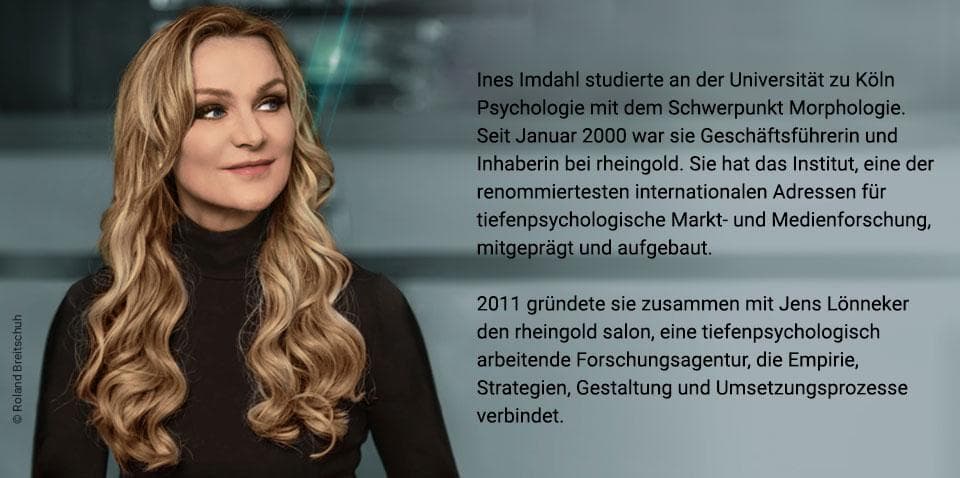
"Media and publishing houses in particular can establish themselves as senders of a podcast on the market. Because they master storytelling more credibly than others. This makes listeners feel safe and more likely to find themselves in a state of suspension. Other companies, on the other hand, only have a chance if the podcast reflects the core competence of their company. Under no circumstances should the impression be created that they only want to sell services. Ultimately, when developing a podcast, it should be taken into account that it must help the listener into the mental state of suspension. Advertising can be very disruptive, but also skillfully integrated," says Ines Imdahl, Managing Director of rheingold salon.
Branded podcasts are more suitable for employer branding
However, respondents are skeptical about classic branded podcasts. They fear a kind of permanent advertising program and biased reporting. But there are also opportunities. For example, companies that use this medium to present themselves as attractive to potential applicants and thus offer their listeners a concrete personal benefit.
Conclusion
Especially in the Corona crisis, podcasts are a piece of freedom from a psychological point of view. Because they send our thoughts on a journey that makes us happier. This makes us feel less fixed and trapped. This is a logical result of the general podcast function: the separation of body and mind.
Methodology
In a first phase, rheingold salon screened and analyzed over 500 statements about podcasts in relevant social media with a focus on branded podcasts. The second phase consisted of three-week online diaries in which 23 participants documented their podcast behavior. 21 people also gave deep insights into their podcast behavior in two- to four-hour groups and interviews, half of whom were women and half men aged between 23-61 years.
Further insights into the study can be found here: